
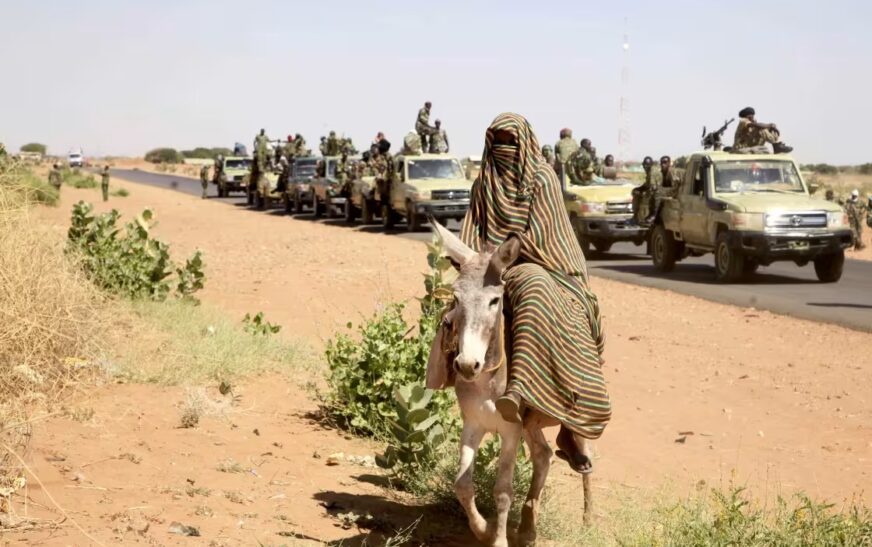
Millions of Sudanese, particularly women and children, have faced, since the outbreak of the war in 2023, a black death descending from the skies, even as its forms have varied—from explosive barrels and indiscriminate, unguided munitions to chemical weapons. Yet the common factor has been, and remains, that they rain down from fighter jets and drones belonging to the Sudanese Armed Forces’ air force, led by Abdel Fattah al-Burhan—the same man who led the military coup against civilian rule in October 2021.
A fact beyond dispute prompted the Council of the European Union, a year into the war, in June 2024, to impose sanctions on military commanders in the Sudanese army. At the time, however, it singled out the “Air Force and its commander, Al-Taher Mohamed Al-Awad Al-Amin,” for his responsibility for indiscriminate aerial bombardments of densely populated residential areas since the beginning of the war.
A month ago, Sudan 360 reported that al-Burhan’s army had used Antonov aircraft to drop explosive barrels on the Al-Jabra area in North Kordofan State, resulting in civilian deaths and injuries, amid mounting U.S. accusations that the Port Sudan authorities were using chemical weapons.
Repeated Attacks
A report by the Daily Star newspaper on Saturday, reveals that “for more than three years now, Sudan has been living under the weight of an ongoing conflict that erupted in mid-April 2023, killing tens of thousands and displacing nearly 14 million others.”
It confirms that, amid developments on the ground, the cities of El Fasher and Kabkabiya in North Darfur came under drone strikes, amid reports of deaths and injuries and damage to a number of homes and public facilities, as an army-affiliated drone targeted several sites in El Fasher for the second consecutive week of bombardment.
The report explains that the strikes came days after a similar raid carried out by the army targeting a gathering of displaced civilians in the Al-Badiya Al-Janoubiya area of Blue Nile State. According to preliminary information, the attack killed and wounded dozens, most of them women and children.
What is striking, however, is that the victims themselves were among those fleeing the ongoing fighting, which has displaced thousands of civilians from their areas, scattering them and depriving them of shelter, grazing areas, and sources of livelihood, amid an almost complete absence of humanitarian assistance and emergency relief, according to the Emergency Lawyers group.
The group condemned the attack in the strongest terms, stressing that targeting civilians and displaced people, who enjoy special protection under international humanitarian law, constitutes a grave violation of the rules governing the protection of civilians and may amount to a war crime if it is established that the attack was deliberately directed against civilians or was carried out indiscriminately and without distinction.
According to a statement by Emergency Lawyers, the attack comes amid escalating violations against civilians in Sudan and the continued targeting of populated areas and displacement sites, reflecting a failure to fulfill legal obligations to protect civilians and keep them away from hostilities.
The report cites an accusation by the African-European Organization for Humanitarian Action and Development against the Sudanese army’s air force, alleging that it carried out repeated airstrikes on populated areas and civilian facilities in several Sudanese states, considering that the pattern of these attacks raises grave concern over the possibility of violations of international humanitarian law.
According to the organization, aircraft belonging to the Sudanese army’s air force carried out raids on July 29 against the village of Sharshar in North Kordofan, noting that preliminary information and photographs it obtained indicated that civilians, including women and children, had been killed and wounded.

It adds that the Umm Qarfah area in North Kordofan was also subjected to an airstrike on July 18, explaining that it received reports of smoke or yellow clouds appearing after one of the strikes, accompanied by cases of suffocation and unusual health symptoms.
It maintains that these incidents should not be viewed as isolated events, but rather as part of a recurring pattern of airstrikes targeting populated areas, markets, roads, bridges, and civilian facilities. It called for a comprehensive investigation into the strikes on Sharshar and Umm Qarfah, alongside an investigation into the targeting of the Ardamata Bridge and an assessment of the resulting humanitarian and legal repercussions.
Bombing Civilian Facilities
The African-European Organization for Humanitarian Action and Development recalls the accusations leveled against the Sudanese army, led by Abdel Fattah al-Burhan, and allied militias of bombing civilian facilities, particularly hospitals and markets—acts that international organizations have described as fully fledged war crimes.
It says that on April 17, 2023, the third day of the outbreak of the Sudanese war, army warplanes bombed the Khartoum Government Hospital near the army’s General Command in the center of the capital, thereby establishing a pattern to which the army has resorted from time to time.
It also draws attention to the killing of more than 62 people and the wounding of 113 others in a drone strike carried out by the army against El Daein Teaching Hospital in East Darfur, western Sudan, according to statements issued by local and United Nations bodies in late March last year.
This recurring approach had previously been documented by Human Rights Watch in June 2025, when it confirmed that the Sudanese army had used unguided bombs dropped from the air to carry out attacks on residential and commercial neighborhoods in Nyala, South Darfur, in early February of the previous year, and that these indiscriminate attacks, which constitute alleged war crimes, killed and wounded large numbers of civilians.
At the time, Jean-Baptiste Gallopin, a senior researcher in the Crisis, Conflict and Arms Division at Human Rights Watch, said: “The Sudanese army bombed densely populated residential and commercial neighborhoods in Nyala using imprecise bombs. These attacks killed dozens of men, women and children, tore families apart, and sowed fear and displacement.”
Later, during 2025, and as another indication of the death descending from the skies, a France 24 report documented “the Sudanese army’s use of chemical weapons in 2024, in the form of chlorine gas, after barrels were dropped from Sudanese army aircraft onto areas of Khartoum. The Sudanese army alone possesses the military aircraft required to carry out this type of raid.”