
By late Sunday afternoon, Hannington Road should be winding down into silence. Offices around Crested Towers close their doors, traffic fades, and the city exhales from a busy week. But then, the sound begins.
A low, rolling hum cuts through the stillness. Wheels scrape against tarmac. Laughter follows. And just like that, the quiet street transforms into an open-air arena for one of Uganda’s fastest-growing underground cultures, skateboarding.
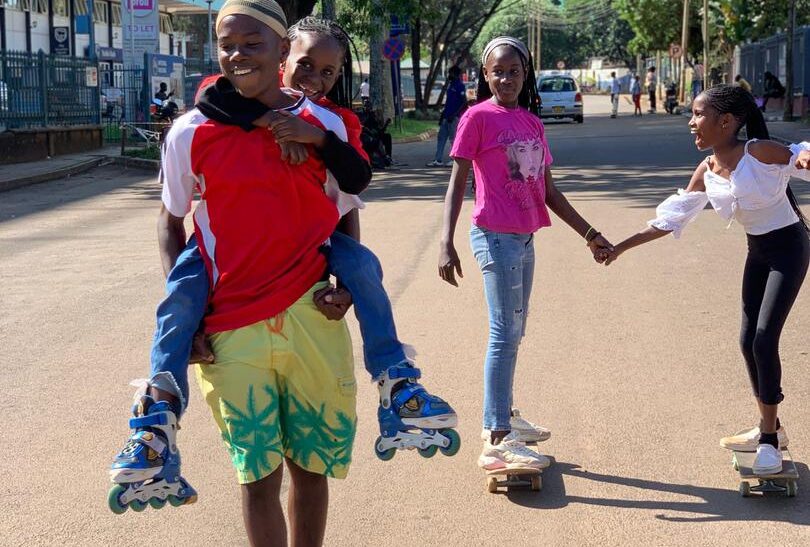
What looks like a casual gathering at first quickly reveals itself as something more organised, more intentional. Skaters sweep across the road with precision, some accelerating with near-mechanical speed, others launching into tricks that draw gasps from onlookers.
Yet beyond the spectacle, there is a different story unfolding. This is not just a space for performance. It is a classroom without walls.
Newcomers arrive hesitant, stepping onto boards for the first time, while seasoned skaters circle back to guide them. Instructions are shared mid-motion, corrections offered between falls, and small victories celebrated as a group. In this space, progress is communal.
Emmanuel Mubiru, founder of Skaters Grind, describes these Sunday sessions as both opportunity and necessity.
“We didn’t always have this space,” he says. “But Sundays gave us a window, a time when the city slows down and we can take over, even if just for a few hours.”
After facing restrictions elsewhere, the group negotiated access with institutions along the street, including Stanbic Bank, securing permission to skate under strict conditions.
“We had to prove that we are disciplined,” Mubiru explains. “This is not chaos. It’s organised.”
That order is visible. There is an unspoken system, everyone is known, and newcomers must introduce themselves. It creates not just safety, but belonging.
In the absence of a proper skate park, Hannington Road has become something else entirely, a training ground, a meeting point, and a cultural hub. It has even drawn in other urban subcultures, from roller skaters to BMX riders, all converging in one shared space.

“It’s bigger than skating,” Mubiru says. “It’s a community.”
Still, the growth of this culture comes with challenges. Skateboards and gear remain expensive and scarce, often arriving as donations from abroad. For many young skaters, earning the right to own a board is a gradual process built on trust and commitment.
Training itself is equally demanding. Beginners learn balance before movement, movement before tricks. Skills like the ollie and kickflip come later, shaped through repetition, patience, and guidance. Even falling is taught, carefully and deliberately.
“Falling is part of the journey,” Mubiru says. “But there’s a way to fall and still get up.”
His own journey mirrors that philosophy. From a curious child in Mutungo to a mentor shaping the next generation, Mubiru’s path reflects the slow but steady rise of skateboarding in Uganda, a movement growing quietly, often unnoticed.
Within the group, the passion is unmistakable. Some speak of freedom, others of escape. For many, skating is simply a different way of experiencing the city.
And perhaps that is what makes Hannington Road remarkable on Sundays. It is no longer just a street. It is a stage, a classroom, and a community space, all rolled into one.
As Kampala continues to evolve, so too does its culture, sometimes not in grand arenas or official programmes, but in small, reclaimed spaces where young people create something of their own.
And every Sunday evening, as the city quiets down, the wheels return, reminding anyone paying attention that something new is rolling forward.